<?xml version='1.0' encoding='UTF-8'?>

<!DOCTYPE article PUBLIC "-//NLM//DTD JATS (Z39.96) Journal Publishing DTD v1.1d1 20130915//EN" "JATS-journalpublishing1.dtd">
<article xmlns:xlink="http://www.w3.org/1999/xlink">
  <front>
    <journal-meta id="journal-meta-87cddb9ab7774ac9973b6a64b7cbc767">
      <journal-id journal-id-type="nlm-ta">Sciresol</journal-id>
      <journal-id journal-id-type="publisher-id">Sciresol</journal-id>
      <journal-id journal-id-type="journal_submission_guidelines">https://jmsh.ac.in/</journal-id>
      <journal-title-group>
        <journal-title>Journal of Medical Sciences and Health</journal-title>
      </journal-title-group>
      <issn publication-format="print"/>
    </journal-meta>
    <article-meta>
        
          
            <article-id pub-id-type="doi">10.47799/pimr.1303.25.6</article-id>
          
          
            <article-categories>
              <subj-group>
                <subject>Original Article</subject>
              </subj-group>
            </article-categories>
            <title-group>
              <article-title>&lt;p&gt;Knowledge of Tuberculosis in Interns and Residents – Are Young Doctors Updated?&lt;/p&gt;</article-title>
            </title-group>
          
          
            <pub-date date-type="pub">
              <day>30</day>
              <month>3</month>
              <year>2025</year>
            </pub-date>
            <permissions>
              <copyright-year>2025</copyright-year>
            </permissions>
          
          
            <volume>13</volume>
          
          
            <issue>3</issue>
          
          <fpage>1</fpage>

          <abstract>
            <title>Abstract</title>
            &lt;p&gt;&lt;bold&gt;Introduction: &lt;/bold&gt;Tuberculosis is significant public health issue in India&lt;emphasis&gt;.&lt;/emphasis&gt; Proper medical education, training of medical graduates, resident doctors are crucial for effective management and control of disease. This study can provide valuable insights where young doctors might need additional training and education for better management of TB cases and contribute to its prevention and control. &lt;bold&gt;Objectives: &lt;/bold&gt;To assess knowledge about tuberculosis in interns and post graduate students. &lt;bold&gt;Methods: &lt;/bold&gt;Prospective study of 136 interns+post graduate students was conducted at tertiary care hospital from 1st July 2023 for duration of eight days through questionnaire which included questions related to disease &lt;superscript&gt;[4]&lt;/superscript&gt;, diagnostic modalities &lt;superscript&gt;[7]&lt;/superscript&gt;, treatment &lt;superscript&gt;[6]&lt;/superscript&gt; along with facilities provided by National Tuberculosis Elimination Program (NTEP) at our institute &lt;superscript&gt;[3]&lt;/superscript&gt;. Questions were prepared on google sheets and circulated. The responses were recorded and analysed. After completion of study, correct answers were emailed to every respondent. &lt;bold&gt;Results: &lt;/bold&gt;Out of 136 responses, 47 responses were from interns and 89 from postgraduate students. Amongst them 88.24 % of respondents were having knowledge about disease, 62.05% were aware about diagnostic modalities, 75.12 % were aware of treatment and preventive measures and 58.33% were updated of facilities provided through NTEP. &lt;bold&gt;Conclusion: &lt;/bold&gt;Up-to-date knowledge and facilities provided by NTEP must be known to young doctors to guide patients for proper diagnosis and treatment. Timely programmed knowledge can help in enhancement of necessary skills, knowledge about disease, diagnostic and treatment modalities, preventive measures and facilities provided by NTEP. This will help in achieving desired goal of Tuberculosis elimination.&lt;/p&gt;
          </abstract>
          
          
            <kwd-group>
              <title>Keywords</title>
              
                <kwd>Interns; NTEP; Resident doctors; Questionnaire; TB elimination</kwd>
              
            </kwd-group>


        <contrib-group>
          
            
              <contrib contrib-type="author">
                <name>
                  <surname>Gautam Shah</surname>
                  <given-names>Pooja</given-names>
                </name>
                
                  <xref rid="aff-1" ref-type="aff">1</xref>
                
              </contrib>


              <aff id="aff-1">
                <institution> Assistant Professor, Department of Microbiology BJ GMC Pune, MUHS Nashik </institution>
                <addr-line>Pune, 411001, Maharashtra India</addr-line>
              </aff>
            
              <aff id="aff-2">
                <institution> Post graduate resident, Department of Microbiology BJ GMC Pune, MUHS Nashik </institution>
                <addr-line>Pune, 411001, Maharashtra India</addr-line>
              </aff>
            
              <aff id="aff-3">
                <institution> Associate Professor, Department of Microbiology BJ GMC Pune, MUHS Nashik </institution>
                <addr-line>Pune, 411001, Maharashtra India</addr-line>
              </aff>
            
              <aff id="aff-4">
                <institution> Professor and Head, Department of Microbiology BJ GMC Pune, MUHS Nashik </institution>
                <addr-line>Pune, 411001, Maharashtra India</addr-line>
              </aff>


              <contrib contrib-type="author">
                <name>
                  <surname>Rajmane</surname>
                  <given-names>Mansi</given-names>
                </name>
                
                  <xref rid="aff-2" ref-type="aff">2</xref>
                
              </contrib>


              <aff id="aff-1">
                <institution> Assistant Professor, Department of Microbiology BJ GMC Pune, MUHS Nashik </institution>
                <addr-line>Pune, 411001, Maharashtra India</addr-line>
              </aff>
            
              <aff id="aff-2">
                <institution> Post graduate resident, Department of Microbiology BJ GMC Pune, MUHS Nashik </institution>
                <addr-line>Pune, 411001, Maharashtra India</addr-line>
              </aff>
            
              <aff id="aff-3">
                <institution> Associate Professor, Department of Microbiology BJ GMC Pune, MUHS Nashik </institution>
                <addr-line>Pune, 411001, Maharashtra India</addr-line>
              </aff>
            
              <aff id="aff-4">
                <institution> Professor and Head, Department of Microbiology BJ GMC Pune, MUHS Nashik </institution>
                <addr-line>Pune, 411001, Maharashtra India</addr-line>
              </aff>


              <contrib contrib-type="author">
                <name>
                  <surname>Satish Pol</surname>
                  <given-names>Sae</given-names>
                </name>
                
                  <xref rid="aff-3" ref-type="aff">3</xref>
                
              </contrib>


              <aff id="aff-1">
                <institution> Assistant Professor, Department of Microbiology BJ GMC Pune, MUHS Nashik </institution>
                <addr-line>Pune, 411001, Maharashtra India</addr-line>
              </aff>
            
              <aff id="aff-2">
                <institution> Post graduate resident, Department of Microbiology BJ GMC Pune, MUHS Nashik </institution>
                <addr-line>Pune, 411001, Maharashtra India</addr-line>
              </aff>
            
              <aff id="aff-3">
                <institution> Associate Professor, Department of Microbiology BJ GMC Pune, MUHS Nashik </institution>
                <addr-line>Pune, 411001, Maharashtra India</addr-line>
              </aff>
            
              <aff id="aff-4">
                <institution> Professor and Head, Department of Microbiology BJ GMC Pune, MUHS Nashik </institution>
                <addr-line>Pune, 411001, Maharashtra India</addr-line>
              </aff>


              <contrib contrib-type="author">
                <name>
                  <surname>Prabhakar Karyakarte</surname>
                  <given-names>Rajesh</given-names>
                </name>
                
                  <xref rid="aff-4" ref-type="aff">4</xref>
                
              </contrib>


              <aff id="aff-1">
                <institution> Assistant Professor, Department of Microbiology BJ GMC Pune, MUHS Nashik </institution>
                <addr-line>Pune, 411001, Maharashtra India</addr-line>
              </aff>
            
              <aff id="aff-2">
                <institution> Post graduate resident, Department of Microbiology BJ GMC Pune, MUHS Nashik </institution>
                <addr-line>Pune, 411001, Maharashtra India</addr-line>
              </aff>
            
              <aff id="aff-3">
                <institution> Associate Professor, Department of Microbiology BJ GMC Pune, MUHS Nashik </institution>
                <addr-line>Pune, 411001, Maharashtra India</addr-line>
              </aff>
            
              <aff id="aff-4">
                <institution> Professor and Head, Department of Microbiology BJ GMC Pune, MUHS Nashik </institution>
                <addr-line>Pune, 411001, Maharashtra India</addr-line>
              </aff>
            
          
        </contrib-group>
        
    </article-meta>
  </front>
  <body>
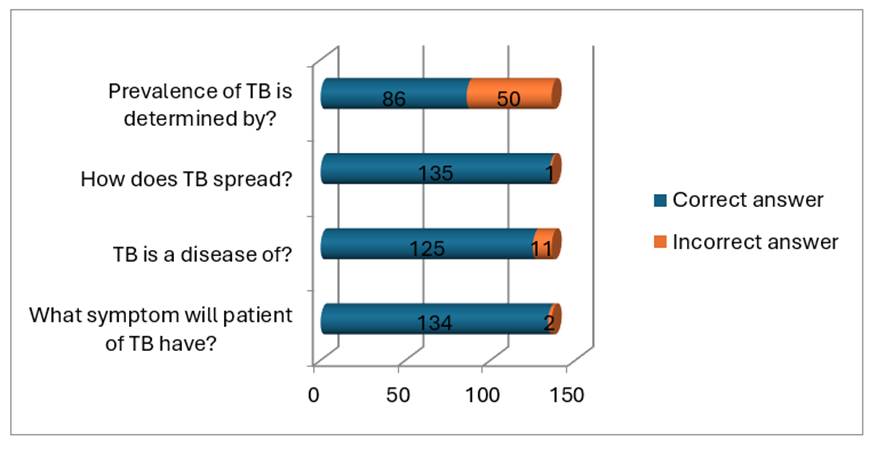
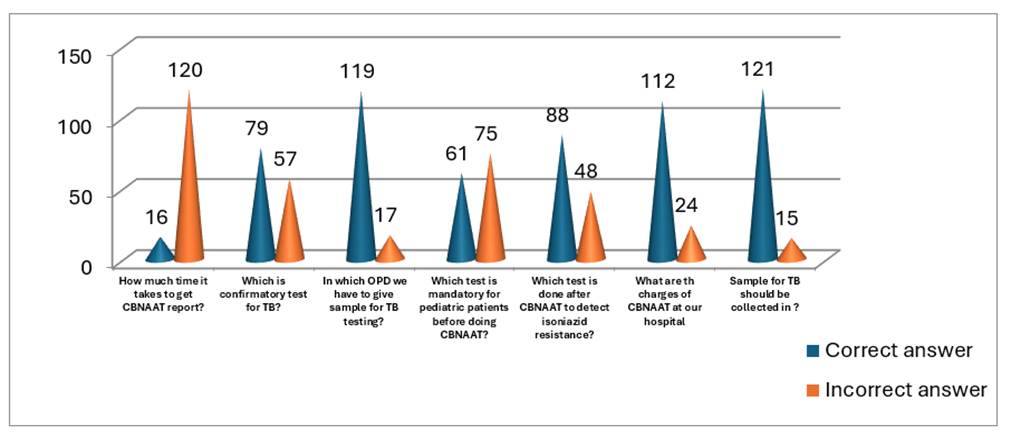
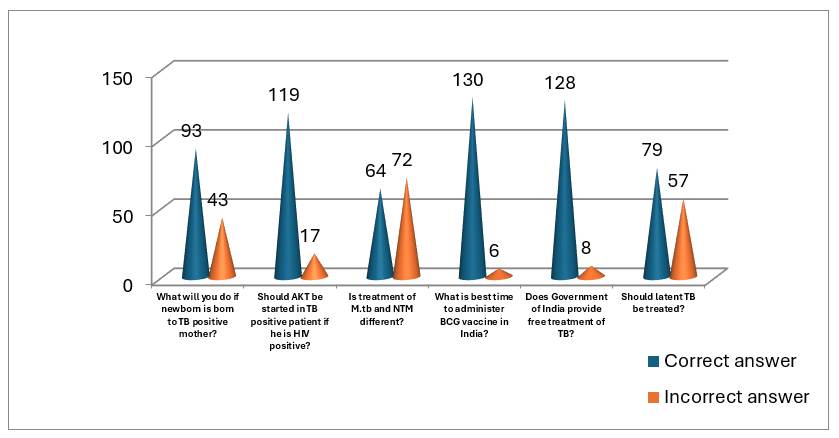
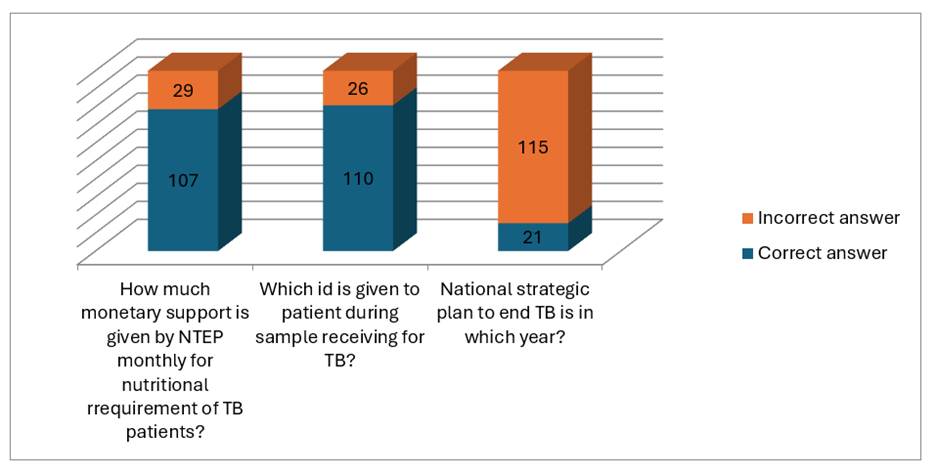
    <heading><span><bold>INTRODUCTION</bold></span></heading><p><span>India accounts for one fourth of global tuberculosis (TB) burden. <superscript>[<xref ref-type="link" rid="#ref-1">1</xref>]</superscript> With such a high incidence of TB in India, the transmission occurs easily from person to person. It is estimated that out of the Indian population that is infected with TB, majority is by latent bacteria and not active TB. <superscript>[<xref ref-type="link" rid="#ref-2">2</xref>, <xref ref-type="link" rid="#ref-3">3</xref>]</superscript> The diagnosis and treatment of tuberculosis have been modified several times since the National Tuberculosis Control Program in 1992 that aims to reduce the TB burden in India. <superscript>[<xref ref-type="link" rid="#ref-4">4</xref>, <xref ref-type="link" rid="#ref-5">5</xref>]</superscript> WHO emphasizes that “the medical school should provide every graduate with the knowledge, skills and attitudes essential of the management of tuberculosis in the patient and in the community as a whole. <superscript>[<xref ref-type="link" rid="#ref-6">6</xref>]</superscript></span></p><p><span>In the health care system, interns /resident doctors come in contact with the patients in course of their duty. It is therefore important for the interns and resident doctors to keep themselves updated regarding the recent guidelines of the National Tuberculosis Elimination Program (NTEP) to protect both patients and them from TB. This study was conducted to assess the knowledge of interns and resident doctors in tertiary care hospitals in Maharashtra regarding tuberculosis.</span><span> </span></p><heading><span><bold>MATERIAL AND METHODS</bold></span></heading><p><span>A prospective study in the form of a questionnaire was conducted in the month of July 2023 for duration of eight days after permission of the ethical committee. Twenty questions were prepared in google sheet and circulated amongst inters and resident doctors. They were asked to fill in general details like age, gender, whether he/she is intern or resident.</span><span> </span></p><p><span>The distribution of the questions was as under</span><span> </span></p><ordered-list><list-item><p><span>Disease - four questions</span><span> </span></p></list-item><list-item><p><span>Laboratory diagnosis - seven questions</span><span> </span></p></list-item><list-item><p><span>Treatment - six questions</span><span> </span></p></list-item><list-item><p><span>NTEP - three questions</span><span> </span></p></list-item></ordered-list><p><span>Time allotted was 20 minutes. The correct answers were mailed to all the participants after eight days.</span><span> Statistical analysis was done by using the chi-square test (p-value ≤ 0.0001 is significant).</span><line-break/> </p><heading><span><bold>RESULTS</bold></span></heading><p><span>The tertiary care hospital included in the study consisted of 250 interns and 391 resident doctors. Out of them 47 interns and 89 post-graduate students (Junior resident-1, 28, Junior resident-2, 38, Junior resident-3, 23) responded to our questionnaire within a response time of eight days. Total males that participated in study were 50 and females that participated in study were 86 (M:F ratio- 0.58:1) </span><span> </span></p><p><span>Age group distribution of the participants was as follows:</span><span> </span></p><p><span>21-25 years - 44</span><span> </span></p><p><span>26-30 years -76</span><span> </span></p><p><span>31-35 years - 12</span><span> </span></p><p><span>36 -40 years -two</span><span> </span></p><p><span>41-45 years -two</span><span> </span></p><p><span>In our study, 88.24 % of the respondents had correct knowledge <xref ref-type="link" rid="#figure-1">[Fig. 1]</xref>. In the present study, 62.05% were aware of the diagnostic modalities <xref ref-type="link" rid="#figure-2">[Fig. 2]</xref>. In the present study, 91.91% had knowledge that TB affects organs other than lungs. In present study, 58.33% were updated of facilities provided through NTEP <xref ref-type="link" rid="#figure-4">[Fig. 4]</xref>.</span><line-break/> </p><heading><span><bold>DISCUSSION</bold></span></heading><p><span>This study was conducted for a duration of eight days in July 2023. A questionnaire was prepared consisting of 20 questions and the time given to solve them was 20 minutes. Out of 250 interns and 391 residents (total 641), 47 interns (18.8%) and 89 residents (22.76%) participated in the study within the designated time of eight days. Overall, young doctors who participated in study were 21.22 %. Male: Female ratio of the participants in the study was 0.58:1. The age of study participants in our group ranged from 21-41 years. The mean age in our study was 27.11 years. The response rate in our study was 21.22 %. The response rate in the study conducted by Natasha et al was 61% while in the study conducted by Mahika et al it was 100%. <superscript>[<xref ref-type="link" rid="#ref-7">7</xref>, <xref ref-type="link" rid="#ref-8">8</xref>]</superscript></span></p><figure><graphic src="https://schoproductionportal.s3.ap-south-1.amazonaws.com/1765284739894.png"/><figcaption><span><bold>Fig. 1: Response of interns and post graduate residents on information about disease [P value &lt;0.0001 which is statistically significant]</bold></span></figcaption></figure><p> </p><figure><graphic src="https://schoproductionportal.s3.ap-south-1.amazonaws.com/1765284739912.png"/><figcaption><span><bold>Fig. 2: Response of interns and post graduate residents on laboratory diagnosis of TB [P value &lt;0.0001 which is statistically significant]</bold></span></figcaption></figure><p> </p><figure id="figure-3"><graphic src="https://schoproductionportal.s3.ap-south-1.amazonaws.com/1765284739920.png"/><figcaption><span><bold>Fig. 3: Response of interns and post graduate residents on prevention and treatment of TB patients [P value &lt;0.0001 which is statistically significant]</bold></span></figcaption></figure><p> </p><figure id="figure-4"><graphic src="https://schoproductionportal.s3.ap-south-1.amazonaws.com/1765284739926.png"/><figcaption><span><bold>Fig. 4: Response of interns and post graduate residents on information about NTEP [P value is 0.0003 which is stastically significant]</bold></span></figcaption></figure><p> </p><p><span>In the study conducted by Behnaz et al, the age included was 22-40 years with mean±SD was 24.74±1.73 years. <superscript>[<xref ref-type="link" rid="#ref-9">9</xref>]</superscript> <superscript> </superscript>In their study also, females who participated in the study were more than males (65.50% females and 34.5% males). In the study conducted by Mahika et al mean age of participation was 23-25 years, and 56.6% of participants were female. <superscript>[<xref ref-type="link" rid="#ref-8">8</xref>]</superscript><superscript> </superscript>In the study conducted by Charkazi et al, 25.8 years was mean age group <superscript>[<xref ref-type="link" rid="#ref-10">10</xref>]</superscript><superscript> </superscript>while in study conducted by Anna et al, the majority of participants were less than 25 years of age (68%). <superscript>[<xref ref-type="link" rid="#ref-11">11</xref>]</superscript><superscript> </superscript>In our study, the females were the majority who participated. </span><span> </span></p><p><span>We divided our questions into four categories- About disease (four), laboratory diagnosis (seven), treatment and prevention (six), NTEP (three). The overall knowledge regarding TB (general questions, questions of diagnosis, treatment, prevention and NTEP) of answers given in other studies were Eilaf et al., - 64.9 %, Laurenttiet al-56%, Ou et al 44.4%, Dorji et al- 41.4%, Priyanka et al 90.85%. <superscript>[<xref ref-type="link" rid="#ref-12">12</xref>-<xref ref-type="link" rid="#ref-16">16</xref>]</superscript></span><span> </span></p><p><span>In our study, 88.24 % of the respondents had correct knowledge <xref ref-type="link" rid="#figure-1">[Fig. 1]</xref>. In the study conducted by Mahika et al, 98.8% correctly identified chief symptoms of TB. <superscript>[<xref ref-type="link" rid="#ref-8">8</xref>]</superscript><superscript> </superscript>In the study conducted by Eilaf et al, only 49% knew that bacteria can circulate in air. <superscript>[<xref ref-type="link" rid="#ref-12">12</xref>]</superscript><superscript> </superscript>In our study we included a similar type of question (How does TB spread?) and 99.26% gave the correct answer. We had included a question regarding symptoms of TB and 98.53% gave the correct answer. In the study conducted by Dorji et al, 72.9% knew cough as symptom of TB, 44.5% chest pain as one of the symptoms, 44.5% weight loss as one the symptom. <superscript>[<xref ref-type="link" rid="#ref-15">15</xref>]</superscript> A good knowledge (97.2%) regarding symptoms of TB was seen in study of Behnaz et al. <superscript>[<xref ref-type="link" rid="#ref-9">9</xref>]</superscript></span><span> </span></p><p><span>In the present study, 91.91% had knowledge that TB affects organs other than lungs. <superscript>[<xref ref-type="link" rid="#ref-9">9</xref>]</superscript> So, overall, good knowledge was seen in young doctors related to basic information of disease in our study.</span><span> </span></p><p><span>In the present study, 62.05% were aware of the diagnostic modalities <xref ref-type="link" rid="#figure-2">[Fig. 2]</xref>. Various studies in which medical students gave correct answers on laboratory diagnosis of TB were, Laurentii et al (54.1%), Ou et al (35.7%), Priyanka et al (94.8%). <superscript>[<xref ref-type="link" rid="#ref-13">13</xref>, <xref ref-type="link" rid="#ref-14">14</xref>, <xref ref-type="link" rid="#ref-16">16</xref>]</superscript> In our study, the interns and residents who answered correctly had either submitted the patients sample for testing or had worked in the pulmonary medicine department. So, they were aware about the type of container used for collection of samples, where to submit it, time required for the report, will be done to detect isoniazid resistance.</span><span> </span></p><p><span>In our study, 58.09% of young doctors were aware about the confirmatory test for TB. In the study conducted by Behnaz et al, 70.1% were aware regarding most sensitive method to diagnose TB <superscript>[<xref ref-type="link" rid="#ref-9">9</xref>]</superscript></span><span> </span><span> and in study conducted by Mahika et al 90% were aware regarding gold standard test. <superscript>[<xref ref-type="link" rid="#ref-8">8</xref>]</superscript></span><span> </span></p><p><span>In the current study, 75.12 % were aware of the treatment and preventive measures <xref ref-type="link" rid="#figure-3">[Fig. 3]</xref>. In the study conducted by Laurentti et al, 63.5% answered correctly regarding epidemiology and prevention, 45.7% gave correct answers on treatment. <superscript>[<xref ref-type="link" rid="#ref-13">13</xref>]</superscript><superscript> </superscript>While in the study conducted by Ou et al, 52.5% and 47.5% answered correctly regarding epidemiology, prevention and treatment respectively. <superscript>[<xref ref-type="link" rid="#ref-14">14</xref>]</superscript><superscript> </superscript>In the study conducted by Priyanka et al, 82.6% were aware regarding Directly Observed Treatment Short course (DOTS). <superscript>[<xref ref-type="link" rid="#ref-16">16</xref>]</superscript> In our study, knowledge regarding treatment was seen more in residents than interns as they are directly involved in treatment of patients.</span><span> </span></p><p><span>In present study, 58.33% were updated of facilities provided through NTEP (chart 4). conducted by Priyanka et al, 70.96% had knowledge regarding the same. <superscript>[<xref ref-type="link" rid="#ref-16">16</xref>]</superscript></span><span> </span></p><p><span>After carrying out this study, it was observed that most of the young doctors were aware about the disease, laboratory diagnosis and treatment. A few points needed to be refreshed with respect to NTEP updated guidelines and non-tubercular mycobacteria. After eight days we emailed the correct answers to 250 interns and 391 resident doctors. This study will be helpful in updating the knowledge of interns and residents according to new NTEP guidelines. </span><span> </span><line-break/> </p><heading><span><bold>CONCLUSION</bold></span></heading><p><span>Updating knowledge in diagnosis, prevention, treatment and facilities given by NTEP is very important in young doctors as they are the ones who will encounter patients first. If caregivers are updated with the knowledge they can provide accurate guidance to patients. This will help in achieving the desired goal of Tuberculosis elimination. </span><span> </span></p><heading><span><bold>Limitations of study</bold></span></heading><p><span>This study was conducted only for a duration of eight days. The sample size of this study is very small. We are planning to conduct a similar study in Maharashtra to see the knowledge of young doctors for more impact. </span><span> </span><line-break/> </p><heading><bold>DISCLOSURE</bold></heading><p><span><bold>Conflict of interest: </bold>No conflict of interest is found elsewhere considering this work. </span></p><p><span><bold>Source of Funding: </bold>There was no financial support concerning this work.</span></p>
  </body>
  <back>
    <ref-list>
      <title>References</title>
      
        
          <ref id="ref-1">
            <element-citation publication-type="journal">
              
                <person-group person-group-type="author">
                  <name>
                    Chavan YB, Shenoy PS
                  </name>
                </person-group>
              
              
                <article-title>Tuberculosis among resident doctors and nurses in a tertiary care hospital</article-title>
              
              
                <source>Journal of Family Medicine and Primary Care</source>
              
              
                <year>2022</year>
              
              
                <volume>11</volume>
              
              
                <issue>5</issue>
              
              
                <uri>https://doi.org/10.4103/jfmpc.jfmpc_1089_21</uri>
              
            </element-citation>
          </ref>


          <ref id="ref-3">
            <element-citation publication-type="journal">
              
                <person-group person-group-type="author">
                  <name>
                    Sangma BK, Shivalingaiah B, Singh WA, Renthlei L, Sangma R
                  </name>
                </person-group>
              
              
                <article-title>Assessment of Knowledge on management of Pulmonary Tuberculosis under RNTCP among graduating Interns and Postgraduate students in RIMS Imphal.</article-title>
              
              
                <source>IOSR Journal of Nursing and Health Science</source>
              
              
                <year>2017</year>
              
              
                <volume>06</volume>
              
              
                <issue>03</issue>
              
              
                <uri>https://doi.org/10.9790/1959-0603010711</uri>
              
            </element-citation>
          </ref>


          <ref id="ref-4">
            <element-citation publication-type="journal">
              
                <person-group person-group-type="author">
                  <name>
                    Mehta D, Singh M, Bassi R, Mehta C
                  </name>
                </person-group>
              
              
                <article-title>To study the knowledge about tuberculosis management and national tuberculosis program among medical students and aspiring doctors in a high tubercular endemic country</article-title>
              
              
                <source>Annals of Tropical Medicine and Public Health</source>
              
              
                <year>2012</year>
              
              
                <volume>5</volume>
              
              
                <issue>3</issue>
              
              
                <uri>https://doi.org/10.4103/1755-6783.98620</uri>
              
            </element-citation>
          </ref>


          <ref id="ref-5">
            <element-citation publication-type="journal">
              
                <person-group person-group-type="author">
                  <name>
                    Baveja S, Dalal P
                  </name>
                </person-group>
              
              
                <article-title>Awareness of the revised national tuberculosis control programme and attitude to tuberculosis patients amongst medical undergraduates</article-title>
              
              
                <source>Journal of Academy of Medical Sciences</source>
              
              
                <year>2012</year>
              
              
                <volume>2</volume>
              
              
                <issue>2</issue>
              
              
                <uri>https://doi.org/10.4103/2249-4855.118663</uri>
              
            </element-citation>
          </ref>


          <ref id="ref-7">
            <element-citation publication-type="journal">
              
                <person-group person-group-type="author">
                  <name>
                    Chida N, Brown C, Mathad J, Carpenter K, Nelson G, Schechter MC &lt;I&gt;et al&lt;/I&gt;
                  </name>
                </person-group>
              
              
                <article-title>Internal Medicine Residents&#x27; Knowledge and Practice of Pulmonary Tuberculosis Diagnosis</article-title>
              
              
                <source>Open Forum Infectious Diseases</source>
              
              
                <year>2018</year>
              
              
                <volume>5</volume>
              
              
                <issue>7</issue>
              
              
                <uri>https://doi.org/10.1093/ofid/ofy152</uri>
              
            </element-citation>
          </ref>


          <ref id="ref-8">
            <element-citation publication-type="journal">
              
                <person-group person-group-type="author">
                  <name>
                    Naik MV, Parrikar AAP, Cacodcar JA
                  </name>
                </person-group>
              
              
                <article-title>Awareness of Tuberculosis and RNTCP among Interns at a Tertiary Care Hospital in Goa</article-title>
              
              
                <source>Epidemiology International</source>
              
              
                <year>2020</year>
              
              
                <volume>05</volume>
              
              
                <issue>03</issue>
              
              
                <uri>https://doi.org/10.24321/2455.7048.202019</uri>
              
            </element-citation>
          </ref>


          <ref id="ref-9">
            <element-citation publication-type="journal">
              
                <person-group person-group-type="author">
                  <name>
                    Behnaz F, Mohammadzade G, Mousavi-e-roknabadi RS, Mohammadzadeh M
                  </name>
                </person-group>
              
              
                <article-title>Assessment of knowledge, attitudes and practices regarding tuberculosis among final year students in Yazd, central Iran</article-title>
              
              
                <source>Journal of Epidemiology and Global Health</source>
              
              
                <year>2013</year>
              
              
                <volume>4</volume>
              
              
                <issue>2</issue>
              
              
                <uri>https://doi.org/10.1016/j.jegh.2013.09.003</uri>
              
            </element-citation>
          </ref>


          <ref id="ref-10">
            <element-citation publication-type="journal">
              
                <person-group person-group-type="author">
                  <name>
                    Charkazi AR,  Kouchaki G,  Nejad MS, Gholizade AH
                  </name>
                </person-group>
              
              
                <article-title>Medical interns&#x27; knowledge of tuberculosis and DOTS strategy in northern Islamic Republic of Iran</article-title>
              
              
                <source>Eastern Mediterranean Health Journal</source>
              
              
                <year>2010</year>
              
              
                <volume>16</volume>
              
              
                <issue>12</issue>
              
              
                <uri>https://doi.org/10.26719/2010.16.12.1251</uri>
              
            </element-citation>
          </ref>


          <ref id="ref-11">
            <element-citation publication-type="journal">
              
                <person-group person-group-type="author">
                  <name>
                    Berg-Johnsen A, Hådem SO, Tamrakar D,  Harstad I
                  </name>
                </person-group>
              
              
                <article-title>A questionnaire of knowledge, attitude and practices on tuberculosis among medical interns in Nepal</article-title>
              
              
                <source>Journal of Clinical Tuberculosis and Other Mycobacterial Diseases</source>
              
              
                <year>2020</year>
              
              
                <volume>20</volume>


                <uri>https://doi.org/10.1016/j.jctube.2020.100173</uri>
              
            </element-citation>
          </ref>


          <ref id="ref-12">
            <element-citation publication-type="journal">
              
                <person-group person-group-type="author">
                  <name>
                    Mohammed EA, Alotaibi HA, Alnemari JF, Althobiti MS, Alotaibi SS, Ewis AA, &lt;I&gt;et al&lt;/I&gt;
                  </name>
                </person-group>
              
              
                <article-title>Assessment of Knowledge, Attitude, and Practice towards Tuberculosis among Taif University Students</article-title>
              
              
                <source>Healthcare</source>
              
              
                <year>2023</year>
              
              
                <volume>11</volume>
              
              
                <issue>20</issue>
              
              
                <uri>https://doi.org/10.3390/healthcare11202807</uri>
              
            </element-citation>
          </ref>


          <ref id="ref-13">
            <element-citation publication-type="journal">
              
                <person-group person-group-type="author">
                  <name>
                    Laurenti P, Federico B, Raponi M, Furia G, Ricciardi W, Damiani G
                  </name>
                </person-group>
              
              
                <article-title>Knowledge, experiences, and attitudes of medical students in Rome about tuberculosis</article-title>
              
              
                <source>Medical Science Monitor</source>
              
              
                <year>2013</year>
              
              
                <volume>19</volume>


                <uri>https://doi.org/10.12659/msm.889515</uri>
              
            </element-citation>
          </ref>


          <ref id="ref-14">
            <element-citation publication-type="journal">
              
                <person-group person-group-type="author">
                  <name>
                    Ou Y, Luo Z, Mou J, Ming H, Wang X, Yan S, &lt;I&gt;et al&lt;/I&gt;
                  </name>
                </person-group>
              
              
                <article-title>Knowledge and determinants regarding tuberculosis among medical students in Hunan, China: a cross-sectional study</article-title>
              
              
                <source>BMC Public Health</source>
              
              
                <year>2018</year>
              
              
                <volume>18</volume>
              
              
                <issue>1</issue>
              
              
                <uri>https://doi.org/10.1186/s12889-018-5636-x</uri>
              
            </element-citation>
          </ref>


          <ref id="ref-15">
            <element-citation publication-type="journal">
              
                <person-group person-group-type="author">
                  <name>
                    Dorji T, Tshering T, Wangdi K
                  </name>
                </person-group>
              
              
                <article-title>Assessment of knowledge, attitude and practice on tuberculosis among teacher trainees of Samtse College of Education, Bhutan</article-title>
              
              
                <source>PLOS ONE</source>
              
              
                <year>2020</year>
              
              
                <volume>15</volume>
              
              
                <issue>11</issue>
              
              
                <uri>https://doi.org/10.1371/journal.pone.0241923</uri>
              
            </element-citation>
          </ref>


          <ref id="ref-16">
            <element-citation publication-type="journal">
              
                <person-group person-group-type="author">
                  <name>
                    Venkatakumar P, Nesan GSCQ, Jain T
                  </name>
                </person-group>
              
              
                <article-title>A Study on the Assessment of Knowledge of Interns in a Tertiary Care Hospital on Revised National Tuberculosis Control Programme and DOTS Guidelines</article-title>
              
              
                <source>Indian Journal of Public Health Research &amp;amp; Development</source>
              
              
                <year>2020</year>


                <uri>https://doi.org/10.37506/ijphrd.v11i5.9348</uri>
              
            </element-citation>
          </ref>
        
      
    </ref-list>
  </back>
</article>