<?xml version='1.0' encoding='UTF-8'?>

<!DOCTYPE article PUBLIC "-//NLM//DTD JATS (Z39.96) Journal Publishing DTD v1.1d1 20130915//EN" "JATS-journalpublishing1.dtd">
<article xmlns:xlink="http://www.w3.org/1999/xlink">
  <front>
    <journal-meta id="journal-meta-87cddb9ab7774ac9973b6a64b7cbc767">
      <journal-id journal-id-type="nlm-ta">Sciresol</journal-id>
      <journal-id journal-id-type="publisher-id">Sciresol</journal-id>
      <journal-id journal-id-type="journal_submission_guidelines">https://jmsh.ac.in/</journal-id>
      <journal-title-group>
        <journal-title>Journal of Medical Sciences and Health</journal-title>
      </journal-title-group>
      <issn publication-format="print"/>
    </journal-meta>
    <article-meta>
        
          
            <article-id pub-id-type="doi">10.47799/pimr.1402.26.44</article-id>
          
          
            <article-categories>
              <subj-group>
                <subject>CASE REPORT</subject>
              </subj-group>
            </article-categories>
            <title-group>
              <article-title>&lt;p&gt;Allergic Fungal Rhinosinusitis Associated with &lt;em&gt;Scopulariopsis brevicaulis&lt;/em&gt;: A Rare Case Report&lt;/p&gt;</article-title>
            </title-group>
          
          
            <pub-date date-type="pub">
              <day>30</day>
              <month>3</month>
              <year>2026</year>
            </pub-date>
            <permissions>
              <copyright-year>2026</copyright-year>
            </permissions>
          
          
            <volume>14</volume>
          
          
            <issue>2</issue>
          
          <fpage>1</fpage>

          <abstract>
            <title>Abstract</title>
            &lt;p&gt;Allergic fungal rhinosinusitis (AFRS) is more commonly implicated worldwide by Dematiaceous fungi, whereas in India, &lt;emphasis&gt;Aspergillus flavus&lt;/emphasis&gt; is more frequently identified. &lt;emphasis&gt;Scopulariopsis brevicaulis&lt;/emphasis&gt; an uncommon cause of sinonasal disease, with very rare reports of its association with AFRS.&lt;/p&gt;&lt;p&gt;We report a case of a 24-year-old immunocompetent male presenting with a four-year history of unilateral nasal obstruction, watery nasal discharge, and sneezing. Radiological evaluation revealed diffuse involvement of left maxillary, ethmoid, frontal, and sphenoid sinuses, suggestive of AFRS. Endoscopic sinus surgery revealed extensive fungal debris and polypoidal mucosa. Direct microscopy demonstrated septate hyaline hyphae, and fungal culture grew &lt;emphasis&gt;Scopulariopsis brevicaulis&lt;/emphasis&gt;. The patient responded well to surgical management alone. This case highlights &lt;emphasis&gt;Scopulariopsis brevicaulis&lt;/emphasis&gt; as a rare etiological agent of AFRS in an immunocompetent host. Recognition of this uncommon presentation underscores the importance of mycological evaluation in chronic rhinosinusitis and reinforces surgery as the cornerstone of management in non-invasive disease.&lt;/p&gt;
          </abstract>
          
          
            <kwd-group>
              <title>Keywords</title>
              
                <kwd>Allergic fungal rhinosinusitis; &lt;I&gt;Scopulariopsis brevicaulis&lt;/I&gt;; Chronic rhinosinusitis; Nasal polyposis</kwd>
              
            </kwd-group>


        <contrib-group>
          
            
              <contrib contrib-type="author">
                <name>
                  <surname>Dhawan</surname>
                  <given-names>Pallavi</given-names>
                </name>
                
                  <xref rid="aff-1" ref-type="aff">1</xref>
                
              </contrib>


              <aff id="aff-1">
                <institution> Assistant Professor, Department of Microbiology Gian Sagar Medical College and Hospital </institution>
                <addr-line>Ram Nagar (Rajpura), Dist. Patiala, Punjab India</addr-line>
              </aff>
            
              <aff id="aff-2">
                <institution> Senior Resident, Department of Microbiology Government Medical College Hospital </institution>
                <addr-line>Chandigarh India</addr-line>
              </aff>
            
              <aff id="aff-3">
                <institution> Associate Professor, Department of Microbiology Government Medical College Hospital </institution>
                <addr-line>Chandigarh India</addr-line>
              </aff>
            
              <aff id="aff-4">
                <institution> Professor, Department of Microbiology Government Medical College Hospital </institution>
                <addr-line>Chandigarh India</addr-line>
              </aff>
            
              <aff id="aff-5">
                <institution> Professor and Head, Department of Otorhinolaryngology Government Medical College Hospital </institution>
                <addr-line>Chandigarh India</addr-line>
              </aff>
            
              <aff id="aff-6">
                <institution> Assistant professor, Department of Microbiology Government Medical College Hospital </institution>
                <addr-line>Chandigarh India</addr-line>
              </aff>
            
              <aff id="aff-7">
                <institution> Professor and Head, Department of Microbiology Government Medical College Hospital </institution>
                <addr-line>Chandigarh India</addr-line>
              </aff>


              <contrib contrib-type="author">
                <name>
                  <surname>Mahajan</surname>
                  <given-names>Alisha</given-names>
                </name>
                
                  <xref rid="aff-2" ref-type="aff">2</xref>
                
              </contrib>


              <aff id="aff-1">
                <institution> Assistant Professor, Department of Microbiology Gian Sagar Medical College and Hospital </institution>
                <addr-line>Ram Nagar (Rajpura), Dist. Patiala, Punjab India</addr-line>
              </aff>
            
              <aff id="aff-2">
                <institution> Senior Resident, Department of Microbiology Government Medical College Hospital </institution>
                <addr-line>Chandigarh India</addr-line>
              </aff>
            
              <aff id="aff-3">
                <institution> Associate Professor, Department of Microbiology Government Medical College Hospital </institution>
                <addr-line>Chandigarh India</addr-line>
              </aff>
            
              <aff id="aff-4">
                <institution> Professor, Department of Microbiology Government Medical College Hospital </institution>
                <addr-line>Chandigarh India</addr-line>
              </aff>
            
              <aff id="aff-5">
                <institution> Professor and Head, Department of Otorhinolaryngology Government Medical College Hospital </institution>
                <addr-line>Chandigarh India</addr-line>
              </aff>
            
              <aff id="aff-6">
                <institution> Assistant professor, Department of Microbiology Government Medical College Hospital </institution>
                <addr-line>Chandigarh India</addr-line>
              </aff>
            
              <aff id="aff-7">
                <institution> Professor and Head, Department of Microbiology Government Medical College Hospital </institution>
                <addr-line>Chandigarh India</addr-line>
              </aff>


              <contrib contrib-type="author">
                <name>
                  <surname>Gulati</surname>
                  <given-names>Neelam</given-names>
                </name>
                
                  <xref rid="aff-3" ref-type="aff">3</xref>
                
              </contrib>


              <aff id="aff-1">
                <institution> Assistant Professor, Department of Microbiology Gian Sagar Medical College and Hospital </institution>
                <addr-line>Ram Nagar (Rajpura), Dist. Patiala, Punjab India</addr-line>
              </aff>
            
              <aff id="aff-2">
                <institution> Senior Resident, Department of Microbiology Government Medical College Hospital </institution>
                <addr-line>Chandigarh India</addr-line>
              </aff>
            
              <aff id="aff-3">
                <institution> Associate Professor, Department of Microbiology Government Medical College Hospital </institution>
                <addr-line>Chandigarh India</addr-line>
              </aff>
            
              <aff id="aff-4">
                <institution> Professor, Department of Microbiology Government Medical College Hospital </institution>
                <addr-line>Chandigarh India</addr-line>
              </aff>
            
              <aff id="aff-5">
                <institution> Professor and Head, Department of Otorhinolaryngology Government Medical College Hospital </institution>
                <addr-line>Chandigarh India</addr-line>
              </aff>
            
              <aff id="aff-6">
                <institution> Assistant professor, Department of Microbiology Government Medical College Hospital </institution>
                <addr-line>Chandigarh India</addr-line>
              </aff>
            
              <aff id="aff-7">
                <institution> Professor and Head, Department of Microbiology Government Medical College Hospital </institution>
                <addr-line>Chandigarh India</addr-line>
              </aff>


              <contrib contrib-type="author">
                <name>
                  <surname>Singla</surname>
                  <given-names>Nidhi</given-names>
                </name>
                
                  <xref rid="aff-4" ref-type="aff">4</xref>
                
              </contrib>


              <aff id="aff-1">
                <institution> Assistant Professor, Department of Microbiology Gian Sagar Medical College and Hospital </institution>
                <addr-line>Ram Nagar (Rajpura), Dist. Patiala, Punjab India</addr-line>
              </aff>
            
              <aff id="aff-2">
                <institution> Senior Resident, Department of Microbiology Government Medical College Hospital </institution>
                <addr-line>Chandigarh India</addr-line>
              </aff>
            
              <aff id="aff-3">
                <institution> Associate Professor, Department of Microbiology Government Medical College Hospital </institution>
                <addr-line>Chandigarh India</addr-line>
              </aff>
            
              <aff id="aff-4">
                <institution> Professor, Department of Microbiology Government Medical College Hospital </institution>
                <addr-line>Chandigarh India</addr-line>
              </aff>
            
              <aff id="aff-5">
                <institution> Professor and Head, Department of Otorhinolaryngology Government Medical College Hospital </institution>
                <addr-line>Chandigarh India</addr-line>
              </aff>
            
              <aff id="aff-6">
                <institution> Assistant professor, Department of Microbiology Government Medical College Hospital </institution>
                <addr-line>Chandigarh India</addr-line>
              </aff>
            
              <aff id="aff-7">
                <institution> Professor and Head, Department of Microbiology Government Medical College Hospital </institution>
                <addr-line>Chandigarh India</addr-line>
              </aff>


              <contrib contrib-type="author">
                <name>
                  <surname>Gupta</surname>
                  <given-names>Nitin</given-names>
                </name>
                
                  <xref rid="aff-5" ref-type="aff">5</xref>
                
              </contrib>


              <aff id="aff-1">
                <institution> Assistant Professor, Department of Microbiology Gian Sagar Medical College and Hospital </institution>
                <addr-line>Ram Nagar (Rajpura), Dist. Patiala, Punjab India</addr-line>
              </aff>
            
              <aff id="aff-2">
                <institution> Senior Resident, Department of Microbiology Government Medical College Hospital </institution>
                <addr-line>Chandigarh India</addr-line>
              </aff>
            
              <aff id="aff-3">
                <institution> Associate Professor, Department of Microbiology Government Medical College Hospital </institution>
                <addr-line>Chandigarh India</addr-line>
              </aff>
            
              <aff id="aff-4">
                <institution> Professor, Department of Microbiology Government Medical College Hospital </institution>
                <addr-line>Chandigarh India</addr-line>
              </aff>
            
              <aff id="aff-5">
                <institution> Professor and Head, Department of Otorhinolaryngology Government Medical College Hospital </institution>
                <addr-line>Chandigarh India</addr-line>
              </aff>
            
              <aff id="aff-6">
                <institution> Assistant professor, Department of Microbiology Government Medical College Hospital </institution>
                <addr-line>Chandigarh India</addr-line>
              </aff>
            
              <aff id="aff-7">
                <institution> Professor and Head, Department of Microbiology Government Medical College Hospital </institution>
                <addr-line>Chandigarh India</addr-line>
              </aff>


              <contrib contrib-type="author">
                <name>
                  <surname>Chaudhary</surname>
                  <given-names>Preeti</given-names>
                </name>
                
                  <xref rid="aff-6" ref-type="aff">6</xref>
                
              </contrib>


              <aff id="aff-1">
                <institution> Assistant Professor, Department of Microbiology Gian Sagar Medical College and Hospital </institution>
                <addr-line>Ram Nagar (Rajpura), Dist. Patiala, Punjab India</addr-line>
              </aff>
            
              <aff id="aff-2">
                <institution> Senior Resident, Department of Microbiology Government Medical College Hospital </institution>
                <addr-line>Chandigarh India</addr-line>
              </aff>
            
              <aff id="aff-3">
                <institution> Associate Professor, Department of Microbiology Government Medical College Hospital </institution>
                <addr-line>Chandigarh India</addr-line>
              </aff>
            
              <aff id="aff-4">
                <institution> Professor, Department of Microbiology Government Medical College Hospital </institution>
                <addr-line>Chandigarh India</addr-line>
              </aff>
            
              <aff id="aff-5">
                <institution> Professor and Head, Department of Otorhinolaryngology Government Medical College Hospital </institution>
                <addr-line>Chandigarh India</addr-line>
              </aff>
            
              <aff id="aff-6">
                <institution> Assistant professor, Department of Microbiology Government Medical College Hospital </institution>
                <addr-line>Chandigarh India</addr-line>
              </aff>
            
              <aff id="aff-7">
                <institution> Professor and Head, Department of Microbiology Government Medical College Hospital </institution>
                <addr-line>Chandigarh India</addr-line>
              </aff>


              <contrib contrib-type="author">
                <name>
                  <surname>Gupta</surname>
                  <given-names>Varsha</given-names>
                </name>
                
                  <xref rid="aff-7" ref-type="aff">7</xref>
                
              </contrib>


              <aff id="aff-1">
                <institution> Assistant Professor, Department of Microbiology Gian Sagar Medical College and Hospital </institution>
                <addr-line>Ram Nagar (Rajpura), Dist. Patiala, Punjab India</addr-line>
              </aff>
            
              <aff id="aff-2">
                <institution> Senior Resident, Department of Microbiology Government Medical College Hospital </institution>
                <addr-line>Chandigarh India</addr-line>
              </aff>
            
              <aff id="aff-3">
                <institution> Associate Professor, Department of Microbiology Government Medical College Hospital </institution>
                <addr-line>Chandigarh India</addr-line>
              </aff>
            
              <aff id="aff-4">
                <institution> Professor, Department of Microbiology Government Medical College Hospital </institution>
                <addr-line>Chandigarh India</addr-line>
              </aff>
            
              <aff id="aff-5">
                <institution> Professor and Head, Department of Otorhinolaryngology Government Medical College Hospital </institution>
                <addr-line>Chandigarh India</addr-line>
              </aff>
            
              <aff id="aff-6">
                <institution> Assistant professor, Department of Microbiology Government Medical College Hospital </institution>
                <addr-line>Chandigarh India</addr-line>
              </aff>
            
              <aff id="aff-7">
                <institution> Professor and Head, Department of Microbiology Government Medical College Hospital </institution>
                <addr-line>Chandigarh India</addr-line>
              </aff>
            
          
        </contrib-group>
        
    </article-meta>
  </front>
  <body>
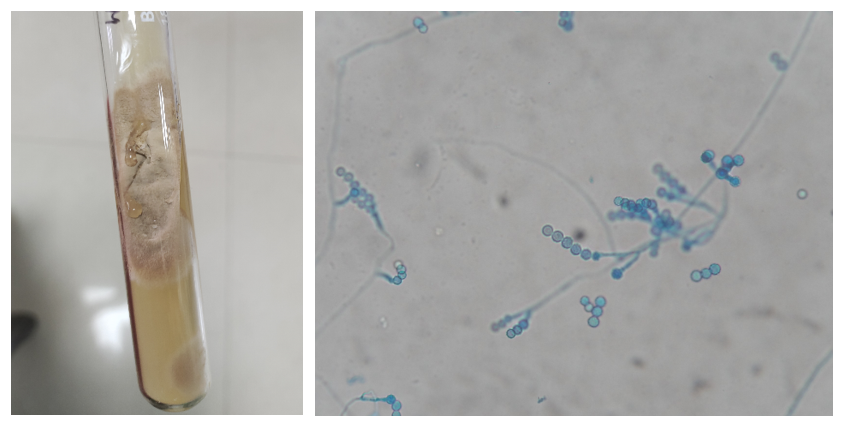
    <heading><span><bold>INTRODUCTION</bold></span></heading><p><span>Allergic fungal rhinosinusitis (AFRS) is a well-recognized non-invasive form of chronic rhinosinusitis characterized by nasal polyposis, eosinophilic allergic mucin, and radiological sinus expansion, typically occurring in immunocompetent individuals. While dematiaceous fungi such as </span><italic><span>Bipolaris</span></italic><span>, </span><italic><span>Curvularia</span></italic><span>, and </span><italic><span>Alternaria</span></italic><span> are more commonly implicated worldwide<superscript>[<xref ref-type="link" rid="#ref-1">1</xref>]</superscript>, </span><italic><span>Aspergillus flavus</span></italic><span> is more commonly identified as the causative agent of AFRS in the indian context<superscript>[<xref ref-type="link" rid="#ref-2">2</xref>]</superscript>.</span></p><p><italic><span>Scopulariopsis brevicaulis</span></italic><span> is traditionally associated with superficial infections such as onychomycosis, keratitis, and otomycosis in immunocompetent hosts<superscript>[<xref ref-type="link" rid="#ref-3">3</xref>]</superscript>. One of the less commonly recognized manifestations includes sinonasal involvement which is quite rare<superscript>[<xref ref-type="link" rid="#ref-4">4</xref>]</superscript>.</span></p><p><italic><span>Scopulariopsis brevicaulis </span></italic><span>has been frequently reported to exhibit resistance to several commonly used antifungal agents, including amphotericin B, azoles such as itraconazole, voriconazole, and posaconazole, as well as terbinafine and flucytosine, echinocandins show inconsistent activity<superscript>[<xref ref-type="link" rid="#ref-4">4</xref>, <xref ref-type="link" rid="#ref-5">5</xref>]</superscript>. </span></p><p><span>Given the rarity of </span><italic><span>Scopulariopsis brevicaulis</span></italic><span> as a causative agent of AFRS and the absence of identifiable risk factors in the present case, reporting such cases is important in expanding the current understanding of its clinical spectrum. This case report highlights the need for mycological evaluation in patients with chronic rhinosinusitis.</span></p><heading><span><bold>CASE REPORT</bold></span></heading><p><span>A 24-year-old male presented to the Otorhinolaryngology Outpatient Department with complaints of left-sided nasal obstruction for four years. The obstruction was insidious in onset, gradually progressive, and intermittent, with exacerbations during episodes of upper respiratory tract infection. The symptoms showed temporary relief with medical treatment but recurred. The patient also reported watery mucoid nasal discharge, which was non-foul-smelling and non-blood-stained, along with excessive sneezing. The patient had no known comorbidities such as diabetes mellitus, hypertension, tuberculosis, or cardiac disease. </span></p><p><span>Otolaryngological examination revealed a grossly midline external nasal framework. Anterior rhinoscopy demonstrated a left-sided deviated nasal septum with bilateral inferior turbinate hypertrophy and a pale polypoidal mass occupying the left nasal cavity. Cold spatula test showed decreased misting on the left side and reduced movement on cotton wool test. Olfaction was intact and no paranasal sinus tenderness. </span></p><p><span>Non-contrast computed tomography (NCCT) of the paranasal sinuses revealed diffuse mucosal thickening involving left maxillary sinus with widening of the maxillary ostium. Additional involvement of the left ethmoid, frontal, and sphenoid sinuses was noted, along with thinning of the left maxillary sinus wall and deviation of nasal septum to left side. Based on the clinical and radiological findings, a diagnosis of left-sided allergic fungal rhinosinusitis with nasal polyposis and deviated nasal septum was made.</span></p><p><span>The patient underwent functional endoscopic sinus surgery. Diagnostic nasal endoscopy revealed a high left-sided deviated nasal septum with a spur. The uncinate process was everted and polypoidal. Middle meatal antrostomy was performed, and the maxillary ostium was widened, revealing fungal debris within the maxillary sinus. Polypoidal mucosa and fungal material were also identified in the anterior and posterior ethmoid sinuses and frontal recess. Anterior and posterior ethmoidectomy, frontal sinusotomy, sphenoidotomy, and left middle turbinectomy were performed to achieve complete clearance. All excised fungal debris and polypoidal tissue were sent for histopathological examination and mycological analysis. </span></p><p><span>Direct microscopic examination of the specimen using potassium hydroxide mount revealed septate, thin-walled, hyaline, branching fungal hyphae. Fungal culture on Sabouraud’s dextrose agar demonstrated moderately fast-growing colonies that were initially white and later became buffy and powdery at the center, with a brownish-tan pigmentation on the reverse. Slide culture revealed numerous branched conidiophores with chains of conidia produced in basipetal succession from solitary annellides. The conidia were globose, truncate, smooth, and brown, consistent with </span><italic><span>Scopulariopsis brevicaulis</span></italic><span> <xref ref-type="link" rid="#figure-1">[Fig. 1]</xref>.<bold> </bold>Histopathological findings showed signs of chronic inflammation and mild eosinophilia with no necrosis or invasion. Hematological investigations also revealed eosinophilia while serum Ig E level could not be documented as they are not performed routinely in the institute.</span></p><figure id="figure-1"><graphic src="https://schoproductionportal.s3.ap-south-1.amazonaws.com/data/PIMR/360/1782909173449.png"/><figcaption><span><bold>Fig. 1: </bold></span><italic><span><bold>Scopulariopsis brevicaulis</bold></span></italic><span><bold>  - growth on Sabourauds’ Dextrose Agar (SDA) and slide culture Lactophenol cotton blue mount</bold></span></figcaption></figure><p> </p><p><span>The postoperative period was uneventful. The patient was discharged with aceclofenac-paracetamol-serratiopeptidase twice daily, montelukast-levocetirizine once daily at bedtime, xylometazoline nasal drops thrice daily, and intranasal corticosteroid spray twice daily. Patient came for follow-up after a month and later at 4 months. Follow-up period was also uneventful.</span></p><heading><span><bold>DISCUSSION</bold></span></heading><p><span>AFRS is typically a non-invasive manifestation of fungal rhinosinusitis occurring in immunocompetent hosts<superscript>[<xref ref-type="link" rid="#ref-4">4</xref>]</superscript>. A key reason this report is clinically important is the uncommon etiologic agent. </span><italic><span>Scopulariopsis</span></italic><span> species are usually regarded as environmental saprophytes and are most often linked to superficial disease, while deep sinonasal disease is rare and more frequently described in immunocompromised hosts<superscript>[<xref ref-type="link" rid="#ref-6">6</xref>]</superscript>. In contrast, our patient had no systemic comorbidities, normal baseline investigations, and no immunosuppressive history.</span></p><p><span>Non-invasive fungal sinusitis described by Rai S et al was observed in an immunocompetent adult male involving the maxillary sinus and responded well to surgery and itraconazole<superscript>[<xref ref-type="link" rid="#ref-7">7</xref>]</superscript>. Sattler </span><italic><span>et al</span></italic><span>. described a non-invasive maxillary “fungal ball” due to </span><italic><span>S. brevicaulis</span></italic><span> in an immunocompetent 70-year-old, where surgery alone achieved good outcome despite the isolate demonstrating high MICs to multiple antifungal agents<superscript>[<xref ref-type="link" rid="#ref-4">4</xref>]</superscript>. In contrast, invasive sinonasal infections attributed to </span><italic><span>Scopulariopsis</span></italic><span> have largely been confined to immunocompromised settings and tend to follow a more aggressive course. Such cases often require a combination of prompt surgical debridement and systemic antifungal therapy to achieve disease control<superscript><superscript>[<xref ref-type="link" rid="#ref-8">8</xref>, <xref ref-type="link" rid="#ref-9">9</xref>]</superscript></superscript>.</span></p><p><italic><span>S. brevicaulis</span></italic><span> presents a constant dilemma with in vitro resistance, interpretive breakpoints lacking, clinical response not correlating well with MICs<superscript>[<xref ref-type="link" rid="#ref-4">4</xref>]</superscript>. Contemporary literature suggests that no single antifungal agent has demonstrated consistent efficacy, and combination regimens with different antifungals have been explored with variable success<superscript><superscript>[<xref ref-type="link" rid="#ref-5">5</xref>, <xref ref-type="link" rid="#ref-9">9</xref>, <xref ref-type="link" rid="#ref-10">10</xref>]</superscript></superscript>. It is important to understand the antifungal susceptibility in such cases, however, in the present case, complete clinical resolution was achieved with surgical excision alone, underscoring the potential adequacy of surgery in non-invasive disease. Nevertheless, certain limitations must be acknowledged. Serum IgE levels were not assessed, which could have provided additional support for the diagnosis of AFRS, and identification of </span><italic><span>Scopulariopsis brevicaulis</span></italic><span> was based solely on phenotypic characteristics without molecular confirmation.</span></p><heading><span><bold>CONCLUSION</bold></span></heading><p><span>This case broadens current understanding of sinonasal </span><italic><span>Scopulariopsis</span></italic><span> by demonstrating that </span><italic><span>S. brevicaulis</span></italic><span> can present as AFRS in an immunocompetent young adult, reinforcing the need for species-level identification. Reporting such uncommon presentations contributes to a better understanding for the role of surgery as the cornerstone of management in such non-invasive disease, while reserving systemic antifungal therapy for carefully selected cases based on host status and disease severity.</span></p><heading><span><bold>Acknowledgement</bold></span></heading><p><span>We acknowledge the contribution of our technical staff, Ms Ruby Suria and Mr Sheetal Kumar</span></p><heading><span><bold>Conflict of interest statement</bold></span></heading><p><span>The authors declare no conflict of interest.</span></p>
  </body>
  <back>
    <ref-list>
      <title>References</title>
      
        
          <ref id="ref-1">
            <element-citation publication-type="journal">
              
                <person-group person-group-type="author">
                  <name>
                    Bent JP, Kuhn FA
                  </name>
                </person-group>
              
              
                <article-title>Diagnosis of Allergic Fungal Sinusitis</article-title>
              
              
                <source>Otolaryngology–Head and Neck Surgery</source>
              
              
                <year>1994</year>
              
              
                <volume>111</volume>
              
              
                <issue>5</issue>
              
              
                <uri>https://doi.org/10.1177/019459989411100508</uri>
              
            </element-citation>
          </ref>


          <ref id="ref-2">
            <element-citation publication-type="journal">
              
                <person-group person-group-type="author">
                  <name>
                    Varun KMG, Kanitha MS, Rejitha IM
                  </name>
                </person-group>
              
              
                <article-title>Fungal infection among patients with chronic rhinosinusitis who underwent endoscopic sinus surgery</article-title>
              
              
                <source>International Journal of Otorhinolaryngology and Head and Neck Surgery</source>
              
              
                <year>2025</year>
              
              
                <volume>11</volume>
              
              
                <issue>1</issue>
              
              
                <uri>https://doi.org/10.18203/issn.2454-5929.ijohns20250114</uri>
              
            </element-citation>
          </ref>


          <ref id="ref-3">
            <element-citation publication-type="journal">
              
                <person-group person-group-type="author">
                  <name>
                    Kaplan NM, Al-Dwairi RA, AlRabadi NN
                  </name>
                </person-group>
              
              
                <article-title>Fungal keratitis due to &lt;I&gt;Scopulariopsis brevicaulis&lt;/I&gt; and a potential promising therapeutic effect of antibacterial agents: A case report</article-title>
              
              
                <source>Medicine</source>
              
              
                <year>2021</year>
              
              
                <volume>100</volume>
              
              
                <issue>49</issue>
              
              
                <uri>https://doi.org/10.1097/md.0000000000028203</uri>
              
            </element-citation>
          </ref>


          <ref id="ref-4">
            <element-citation publication-type="journal">
              
                <person-group person-group-type="author">
                  <name>
                    Sattler L, Sabou M, Ganeval-Stoll A, Dissaux C, Candolfi E, Letscher-Bru V
                  </name>
                </person-group>
              
              
                <article-title>Sinusitis caused by &lt;I&gt;Scopulariopsis brevicaulis&lt;/I&gt;: Case report and review of the literature</article-title>
              
              
                <source>Medical Mycology Case Reports</source>
              
              
                <year>2014</year>
              
              
                <volume>5</volume>


                <uri>https://doi.org/10.1016/j.mmcr.2014.05.003</uri>
              
            </element-citation>
          </ref>


          <ref id="ref-5">
            <element-citation publication-type="journal">
              
                <person-group person-group-type="author">
                  <name>
                    Korvin K, Chiarruzi M, Martin A, Gromoff C, Ciobotaru V, Sasso M, &lt;I&gt;et al&lt;/I&gt;
                  </name>
                </person-group>
              
              
                <article-title>Endocarditis caused by &lt;I&gt;Scopulariopsis brevicaulis&lt;/I&gt; with disseminated emboli and multiple vascular aneurysms: A case report and literature review</article-title>
              
              
                <source>IDCases</source>
              
              
                <year>2025</year>
              
              
                <volume>42</volume>


                <uri>https://doi.org/10.1016/j.idcr.2025.e02366</uri>
              
            </element-citation>
          </ref>


          <ref id="ref-6">
            <element-citation publication-type="journal">
              
                <person-group person-group-type="author">
                  <name>
                    Jabor MA, Greer DL, Amedee RG
                  </name>
                </person-group>
              
              
                <article-title>Scopulariopsis: An Invasive Nasal Infection</article-title>
              
              
                <source>American Journal of Rhinology</source>
              
              
                <year>1998</year>
              
              
                <volume>12</volume>
              
              
                <issue>5</issue>
              
              
                <uri>https://doi.org/10.2500/105065898780182453</uri>
              
            </element-citation>
          </ref>


          <ref id="ref-7">
            <element-citation publication-type="journal">
              
                <person-group person-group-type="author">
                  <name>
                    Rai S, Tiwari R, Sandhu SV, Rajkumar Y
                  </name>
                </person-group>
              
              
                <article-title>Hyalohyphomycosis of maxillary antrum</article-title>
              
              
                <source>Journal of Oral and Maxillofacial Pathology</source>
              
              
                <year>2012</year>
              
              
                <volume>16</volume>
              
              
                <issue>1</issue>
              
              
                <uri>https://doi.org/10.4103/0973-029x.92996</uri>
              
            </element-citation>
          </ref>


          <ref id="ref-8">
            <element-citation publication-type="journal">
              
                <person-group person-group-type="author">
                  <name>
                    Gluck O, Segal N, Yariv F, Polacheck I, Puterman M, Greenberg D, &lt;I&gt;et al&lt;/I&gt;
                  </name>
                </person-group>
              
              
                <article-title>Pediatric invasive sinonasal &lt;I&gt;Scopulariopsis brevicaulis&lt;/I&gt; - a case report and literature review</article-title>
              
              
                <source>International Journal of Pediatric Otorhinolaryngology</source>
              
              
                <year>2011</year>
              
              
                <volume>75</volume>
              
              
                <issue>7</issue>
              
              
                <uri>https://doi.org/10.1016/j.ijporl.2011.03.026</uri>
              
            </element-citation>
          </ref>


          <ref id="ref-9">
            <element-citation publication-type="journal">
              
                <person-group person-group-type="author">
                  <name>
                    Ellison MD, Hung RT, Harris K, Campbell BH
                  </name>
                </person-group>
              
              
                <article-title>Report of the first case of invasive fungal sinusitis caused by &lt;I&gt;Scopulariopsis acremonium&lt;/I&gt;: review of scopulariopsis infections</article-title>
              
              
                <source>Archives of Otolaryngology–Head &amp;amp; Neck Surgery</source>
              
              
                <year>1998</year>
              
              
                <volume>124</volume>
              
              
                <issue>9</issue>
              
              
                <uri>https://doi.org/10.1001/archotol.124.9.1014</uri>
              
            </element-citation>
          </ref>


          <ref id="ref-10">
            <element-citation publication-type="journal">
              
                <person-group person-group-type="author">
                  <name>
                    Nevil V, Suma R, Arjun GM, Pooja P
                  </name>
                </person-group>
              
              
                <article-title>Orbital apex syndrome due to scopulariopsis: a rare case report</article-title>
              
              
                <source>International Journal of Advances in Medicine</source>
              
              
                <year>2015</year>


                <uri>https://doi.org/10.18203/2349-3933.ijam20150569</uri>
              
            </element-citation>
          </ref>
        
      
    </ref-list>
  </back>
</article>